



It was August, the beginning of the school year and I would turn 8 that year. I clumsily washed myself, wearing a white shirt with green jeans that had some blossom flowers on the pockets. I was in a ponytail without a hat because I didn’t have time to find it buried somewhere deep in the closet. I wore green slippers that my feet were starting to outgrow. Nobody wears shoes here and I didn’t wear shoes daily until I was in my second year of university. It was just past 6:00 am and I was already late, not for school but to meet my friends for breakfast; I grabbed my schoolbag and headed out the door.
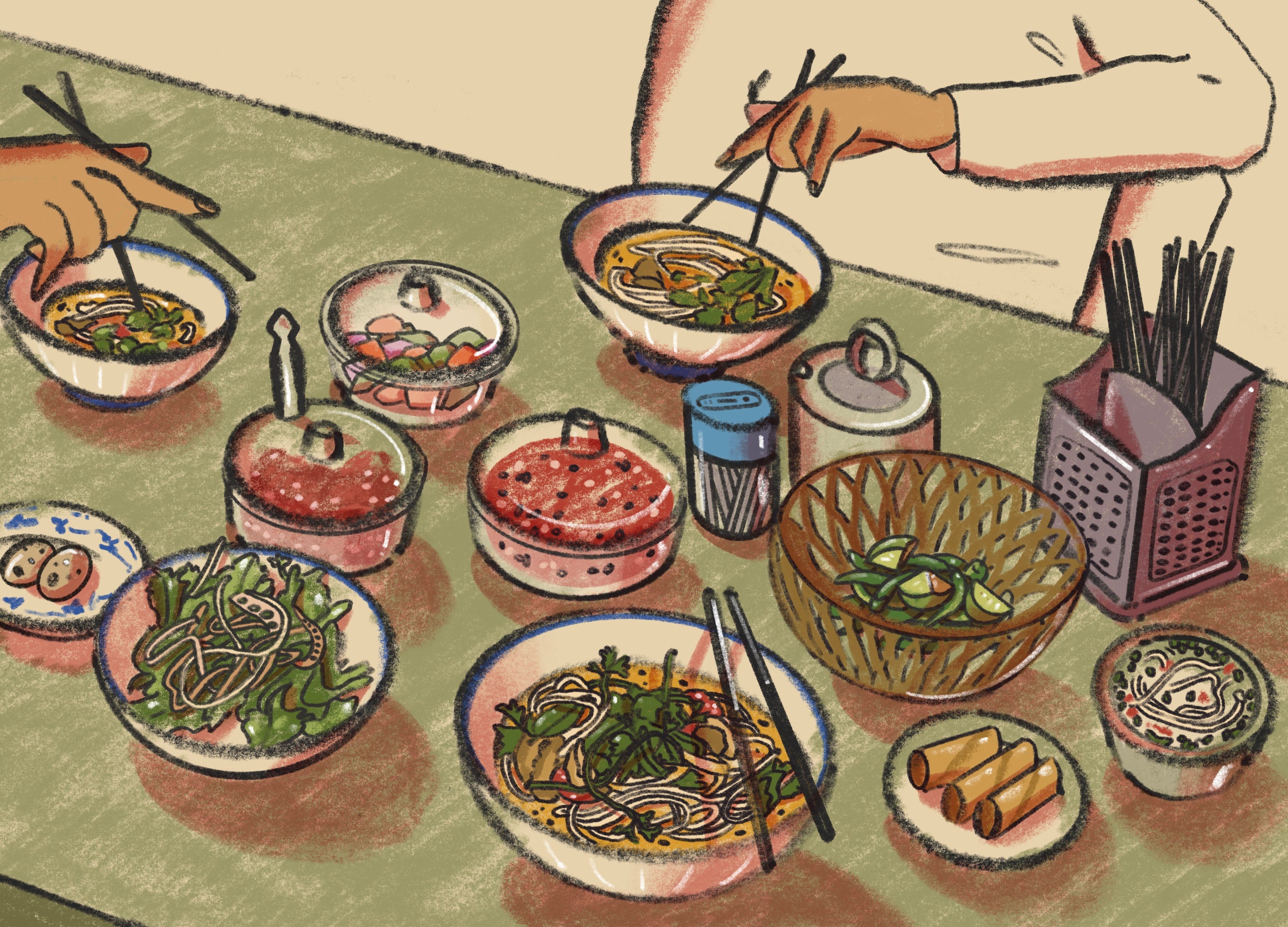
It was August, the beginning of the school year and I would turn 8 that year. I clumsily washed myself, wearing a white shirt with green jeans that had some blossom flowers on the pockets. I was in a ponytail without a hat because I didn’t have time to find it buriedsomewhere deep in the closet. I wore green slippers that my feet were starting to outgrowthat looked too small on me already. Nobody wears shoes here and I didn’t wear shoes daily until I was in my second year of university. It was just past 6:00 am and I was already late, not for school but to meet my friends for breakfast; I grabbed my schoolbag and headed out the door.
I walked along the river bank, watched the sunrise in front of me, the morning breeze touched my tiny face, so fresh and so good. The entire walk over, I kept hoping that my friends wouldn’t get impatient waiting for me. The worry lifted from my shoulders when I saw them gathered in front of Ms. Hoa’s house, where she also sold her Cháo Canh, rice noodle soup with fish. We were always her first customers of the day for nearly the last 2 years. Each time she served us a bowl of freshly hot soup, she was witness to the moments of us growing up.
We were kids born and raised in La Ha, a small island village in Quang Binh1, surrounded by water. Our families were all poor, we walked to school by ourselves, walked home by ourselves and spent our childhood playing in the fields. It always feels like a dream to think about this time, when all our houses looked the same. I was living with my mom and sister together in a small tile-roofed house and anytime it rained, the water would easily flood my house. I hated it so much because my bed was part of the damage each time. My dad was somewhere in Sai Gon, a place I knew nothing about; it didn’t bother me too much until he came back 10 years later. We had a big garden but most of them were sweet potatoes and water spinach which didn’t provide more than just some meals during summer. There was no fence around my house nor for others. It was never really hard for me to escape and see friends during nap time.
The only things people could do to make ends meet in such a village was to craft some local products to sell to vendors, sell food in the market, or become a fisherman: my mom had tried all of them. The path most people chose was to leave the village and go to big cities which was the decision of my dad – and later on, me
Sadly, there were no shops or restaurants, only a daily market by the river opened from 5:00 a.m. to 7:30 a.m. That’s why we called it Chợ Mai - “The Sunrise Market”. If there was any food that all villagers loved to eat here, it would be Cháo Canh, and having it for breakfast was something our parents never complained about.
Ms. Hoa was the first one to open a vendor here and was among the only two ladies selling this dish in the market. We loved her spot because the view faced the river, and it was spacious to sit. Ms. Hoa didn’t even need to look to know we were coming; she could hear our chatter from two blocks away. We would take our seats, and she would start cooking, already knowing what we wanted.
The fish widely chosen for this dish is catfish. Ms. Hoa usually used the ones her husband got from the boatman early in the morning. After being boiled, the flesh would be carefully collected to be sauteed. Sliced shallots are added to burning hot oil until golden, then our boiled catfish, stirred until you can see some parts of it get burned. Ms. Hoa finishes it off with fish sauce and MSG which brings everything together.
Now to finally create the soup, she would boil some water, add the sautéed catfish. She then seasoned the soup with a bit of salt and lastly, the rice noodles were added. Just as the water came up to a boil again, she would turn off the heat, take the pot off, add more MSG and serve each bowl with green onions. Our breakfast was ready.
The main role of fish in this soup is to create a natural sweetness essential for any kind of soup in this world. This instant way of cooking didn’t create a thick broth with deep flavor but rather a light and fresh taste of all ingredients.
We loved adding chili oil to the soup and challenged each other to see who could handle the most. Once, a classmate and I got so competitive that we burned our mouths so badly. Ms. Hoa was worried, but at that age, we never listened to advice.We all loved to share with her what happened in our school life: how we secretly put a caterpillar between our teacher’s book, how I lost my teeth eating rock candies during a lesson, and how my love letter to my classmate became exposed. She loved our stories and listened intently. I didn’t remember any smiles from my primary teachers but I always remembered how Ms. Hoa greeted us with a smile every morning. I didn’t know then that these moments would end once we finished primary school.
Today I woke up at 9:00 am, it is mid-August. I’m no longer a student and the friends I grew up with are all but gone. We left our village to chase opportunities:some off to college, others to jobs. I hope that life will be kinder to us, allowing us to build lives different from our parents’.
I’m standing in a city with countless breakfast options, yet I can’t decide what to eat. Back in university, I would often skip breakfast entirely or just grab something on the run. Today, though, all I can think about is the Cháo Canh I used to share with my friends at 6:00a.m. I miss that soup everyday. Each time I think of home and my peaceful childhood in the village, I think of those breakfasts first.
I rarely eat it when I’m far from home, simply because it isn’t popular elsewhere and the ingredients are hard to find. You don’t realize how special something is until you spend hours trying to satisfy the craving for a dish that only exists in your hometown. It sounds silly in this day and age, but it’s true. The name cháo canh is unique in itself. “Cháo” means porridge and “canh” means soup, but it isn’t actually a rice porridge. It’s more of a hearty noodle soup made with chewy rice flour or hand-cut wheat noodles—somewhat similar to Japanese udon in texture—served in a savory, slightly thickened broth.
What sets Quảng Bình’s cháo canh apart from many other local versions is its thinly rolled, chewy noodles: the rice noodle version is more popular. Made from rice flour, sometimes blended with a touch of tapioca for elasticity, these noodles are softer and silkier, lacking the chewiness of their wheat counterparts. Their slight translucence and smooth texture gives the dish a cleaner, lighter feel. The lack of starch doesn’t thicken the broth, allowing it to remain clear. We always ate it with a side of ram cuốn (fried spring rolls). I simply can’t find this quality anywhere else.
I have tried many noodle soups across Vietnam but cháo canh feels both familiar and unique. You can always say that it is different from all the popular soup like Phở or Bún Bò Huế. Phở and Bún Bò Huế showcase the complicity of Vietnamese cooking technique, diversity in flavor and luxury in ingredients as they were originally dishes associated with the higher class. Cháo Canh, in contrast, reflects the simplicity of common people and resourcefulness of everyday cooking.
The broth is warm and comforting, yet thicker than most Vietnamese noodle soups - a gentle cloudiness that clings to the spoon. Most restaurants nowadays use pork bone for the broth, it helps to create a richer texture. The slow simmering releases collagen and fat, giving the soup a body that feels fuller and more indulgent. But the version I was more familiar with was made from hot water only, a convenient and economical way of cooking that reflects the humble origins of the dish. Instead of relying on long hours of simmering bones, the flavor came mainly from the ingredients added directly into the pot
Years ago, my mom would sometimes send me a package of these dried noodles2 but they would last long, so I ended up wasting most of them. Unlike me, my mom preferred the wheat noodles and every time we hung out after her work, we would eat Cháo Canh before heading home.
I grew up in the market, helping mom with her vendor whenever I wasn’t in school. Mom started selling food there when I was five, she sold all sorts of things from soymilk, donuts, fruits to even sticky rice. I spent most of my days off and my summer break in the market and it is there where I learned many first lessons in life.
She and my sister would wake up at 3:00 am while I slept until 5:00 am to walk to the market with her. All the aunties in the market loved to gather after they finished their job at the Cháo Canh shop and I loved to follow mom wherever she went. It was the only memories I had with mom back then. The market would close around 8:00 am and if she had more food to sell, would ride her broken bicycle to the other village’s market in order to finish her work. I, of course, would follow her. Just like that, I tried Cháo Canh in different markets with mom. While mom was witnessing me growing up, I was watching her getting older through each bowl of soup.
There was something I found in her while she was in the market: freedom. This took me 20 years to realize it. That as a woman, she only had control over what she did only when in the market.
Since high school, I stopped going to the market with her asI needed to focus on studying for university. I rarely had breakfast with her and instead I started to make more friends in a new school in another part of town. We ate Chao Canh together but it felt different than when I was 8. I don’t remember our conversations or it feeling special. I don’t even remember the vendors. I grew up fast and I didn’t even realize it.
When life becomes too heavy, I miss this soup. I close my eyes and trace the walk along the riverbank toward Ms. Hoa’s stall. My childhood friends are laughing beside me, my mother is passing me a bowl, the smell of steaming broth curling into the morning air. At that moment, I was eight years old again.
I have since tasted countless dishes in countless cities, and though life has grown easier in many ways, a part of me still aches to remember what it felt to eat those noodles everyday growing up.
Quang Binh (Now known as Quang Tri) is a coastal province in the Central of Vietnam. It used to be the city separating North and South Vietnam.
beautiful story