


The story of how Hainanese migration, multilingualism, and strong kopi shaped Malaysia’s everyday third place.
I cannot remember the first time I visited a kopitiam - they are as ubiquitous as they are fluid in definition. My last visit was in Taman OUG, a suburb in southwest Kuala Lumpur (KL), on a drizzly Monday morning. The street was busy with shopfronts and market stalls selling fruits, snacks, hardware supplies, and a plethora of other items. The kopitiam, Restoran Eng Huat Kopitiam, was surrounded by black canvas awnings with food vendors and their stalls spilling out onto the streetside. From the street you could watch the vendors skillfully wielding handheld sieves, dunking them in and out of a steaming pot to blanch things like noodles, vegetables, and fish balls, and slinging these ingredients into bowls to be tossed with seasonings and sauces. The shop’s interior was steamy and chaotic - patrons loudly chatted over each other, chairs scraped back and forth from tables, roasted meats were rhythmically chopped on wooden boards, and aunties gave orders to their staff.
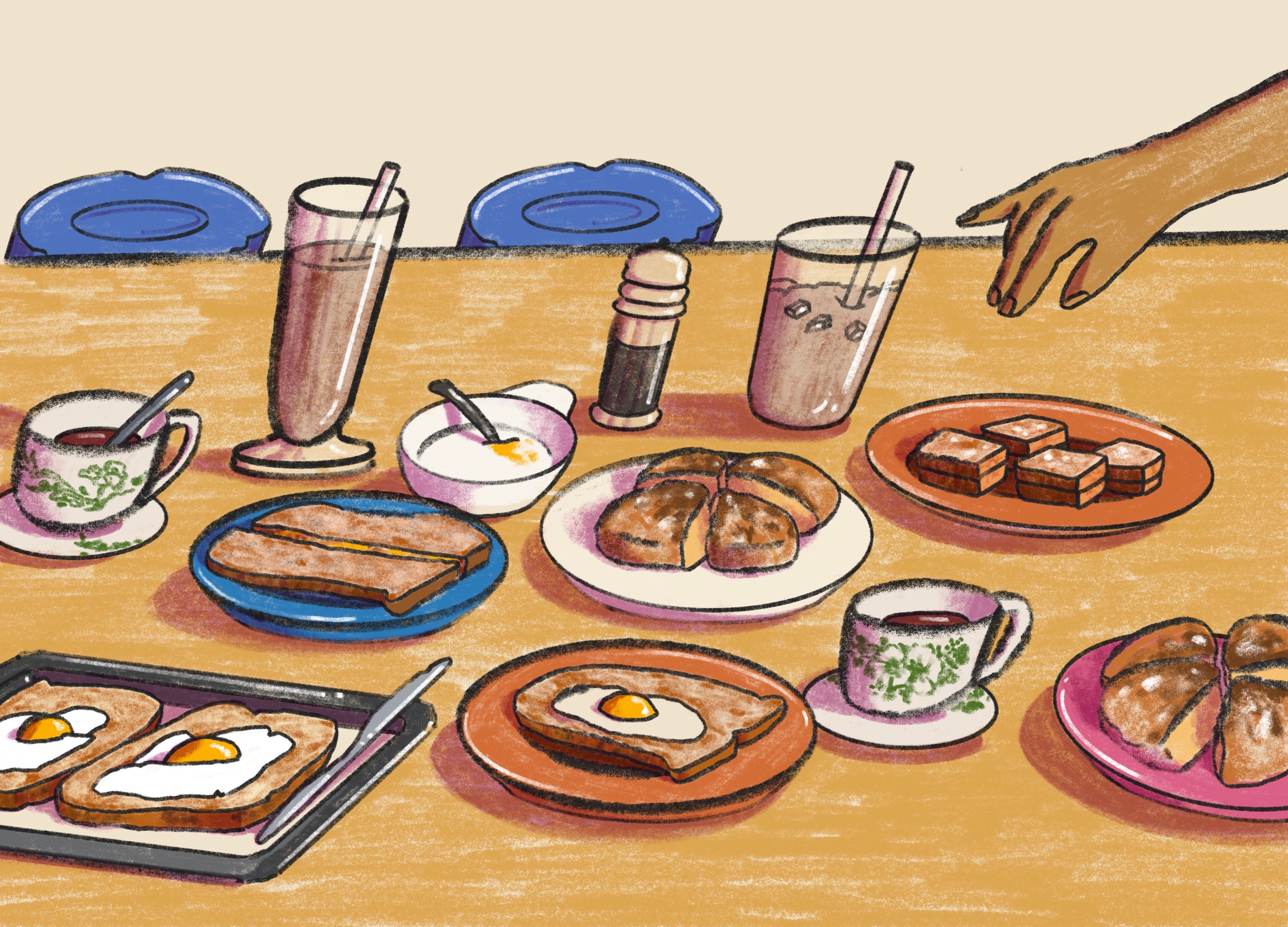
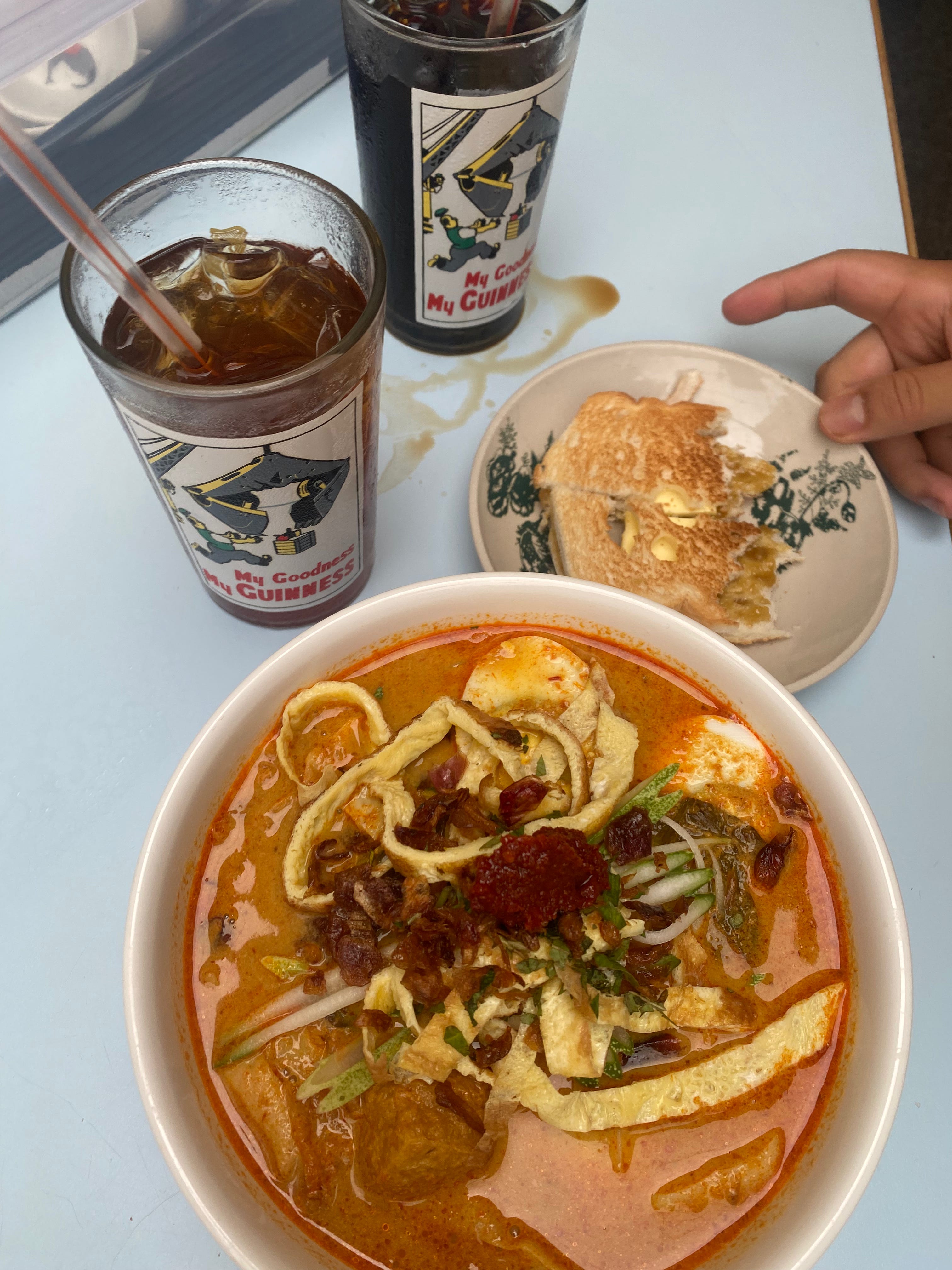
Kopitiams - a combination of the Malay word for coffee, Kopi, and the Hokkien word for shop, Tiam - anchor neighbourhoods across Malaysia. No two are exactly alike, but within them you can find a common thread. From the early morning hours, steaming cups of coffee clinking over saucers which catch their spills, glass mugs1 of milky tea brimming with ice and froth, and plates of toasted bread slathered thick with butter or served with barely-done eggs are shuffled out to tables of awaiting patrons.
Today, kopitiams take on a multitude of forms and configurations. At the most basic level, a kopitiam may be a simple storefront or stall offering coffee, tea and a simple breakfast menu of eggs and toast. Toh Soon Cafe in Penang is an example of this; the shop fills an alleyway wedged in between two buildings, where underneath electric wall fans and mismatched umbrellas are plastic stools filled with hungry customers dipping toast into soft eggs and slurping ice coffee. The open, linear kitchen allows one to view staff carrying out orders as if part of a production line.
In these spaces, you can expect to be served by apron-wearing uncles and aunties whose words are kept to a minimum. As an English speaker, communication is often through gestures and pointing, while orders are acknowledged with a simple nod of the head or single-word phrases. Typically casual but curt, staff are unlikely to rush you unless you are in a particularly busy location or one popular with tourists.
Larger kopitiams operate almost like a food court or hawker, in which multiple vendors rent spaces within the shop selling individual dishes, while the proprietor of the shop maintains the monopoly on beverage sales2. Service is typically fast and efficient, particularly during the morning rush, with customers expected to approach and order their food at its respective stall. Drink orders, however, are usually taken at the table by a server milling about the floor. Think fast - servers tend to approach within a matter of seconds after sitting down.


This is not to be confused with the hawkers of Singapore, however. The key difference is that hawkers in Singapore are owned by Government agencies and each stall is an independent operator. This type of hawker still exists in Malaysia, but is far less common.
The inception of the kopitiam is traced back to the migration of Chinese people to the Malay Peninsula around the 19th century, generally from the Hainan province. As other Chinese dialect groups, such as the Hokkien and Teochew, had already settled in the region and begun to carve out their own space in the economic landscape of British Malaya, the Hainanese looked to other ventures, often working as chefs in British military camps3. Their success in this enterprise led them to open their own establishments across the country4, thereby creating a foundational steer in the trajectory of Malaysia’s coffee culture.
It is said that 90% of Malaysians live within 1 kilometre of a kopitiam - they are truly ‘third places’5 in every sense of the word. From groups of elderly men chatting animatedly over their newspapers, solo diners mindfully sipping coffee, and couples hunched over colourful melamine bowls of noodles, Kopitiams function as “democratic spaces where CEOs and construction workers share tables, dissolving socioeconomic hierarchies in a manner reminiscent of Parisian bistros or Tokyo’s izakayas”6.
A hallmark of kopitiams is their signature kopi cup and saucer. The white porcelain cup and saucer, embellished with a green floral motif, has been used in kopitiams since their origin. The set serves multiple functions; allowing servers to balance several cups at once during busy periods, and also doubling up as a plate for baked goods and toasts to be served alongside the kopi. While these signature cups have been phasing out over the years in favour of glass mugs (which tend to be more affordable and easier to carry), they remain a key part of kopitiam imagery.


You can’t neatly fit a kopitiam into any box, but what you can rely on is a build-your-own-adventure menu of drinks which is sure to satisfy any taste and preference. If you’re lucky, the shop may have a written menu or a board on the wall. Within the kopitiam setting, staff are likely to be speaking one of the many Chinese dialects used across the country, or even a blend of several. Due to the diversity of the country, multilingualism is extremely common; however, learning the basics of the kopitiam menu is quite straightforward and extremely worthwhile. Even if you make a mistake, it’s a low stakes game - I recall many a time being chuckled at by an auntie for my uncertain ordering skills, and have often ended up with something quite unlike what I had in mind (yet nonetheless delicious). Staff will usually approach your table to take drink orders - often without providing a menu as the selection is quite standardized. For this reason, having a go-to drink order or two that you can remember will come in handy.
Similarly to the branded terminology of international chains like Starbucks, kopitiams have a lexicon of their own. You start with your base, ‘teh’ (tea) or ‘kopi’ (coffee). From there, you apply a series of suffixes to indicate temperature, sweetness, or whether you’d like to add milk. The suffix ‘-kosong’ indicates that you would like zero sugar, while ‘-peng’ or ‘-ais’ is used to request a beverage on ice. To request a drink without milk, simply add an ‘-O’ on the end.
The vocabulary is an amalgam of Malay, Hokkien, Cantonese, Hainan and other Chinese dialects, and is reflective of the diversity of language and cultures across the country. The terminology used can also change depending on where you are in Malaysia or in Singapore. It’s not something that is well-documented, but by trawling social media forums you can find discussions over lexical variants7.
“What about “ping”? Got bewildered faces a couple of times when I ordered Kopi O Peng instead of Ping at [a] peninsular chinese [sic] kopitiam. Or was it because not many people order Kopi O with ice?”8
“This list [is] from Singapore. Standard order is siew dai for less sweet. In Malaysia we say cheah, siew tim or sau tian or kurang manis for less sweet.”9
“In Sabah we only have 3 types of coffee. Kopi O, Kopi O Kaw and Kopi (kopi susu). No fancy names, we like to keep it simple.”10
The possibilities are endless and would be almost impossible to list entirely, however, below is a selection of drinks you will typically find in a kopitiam:
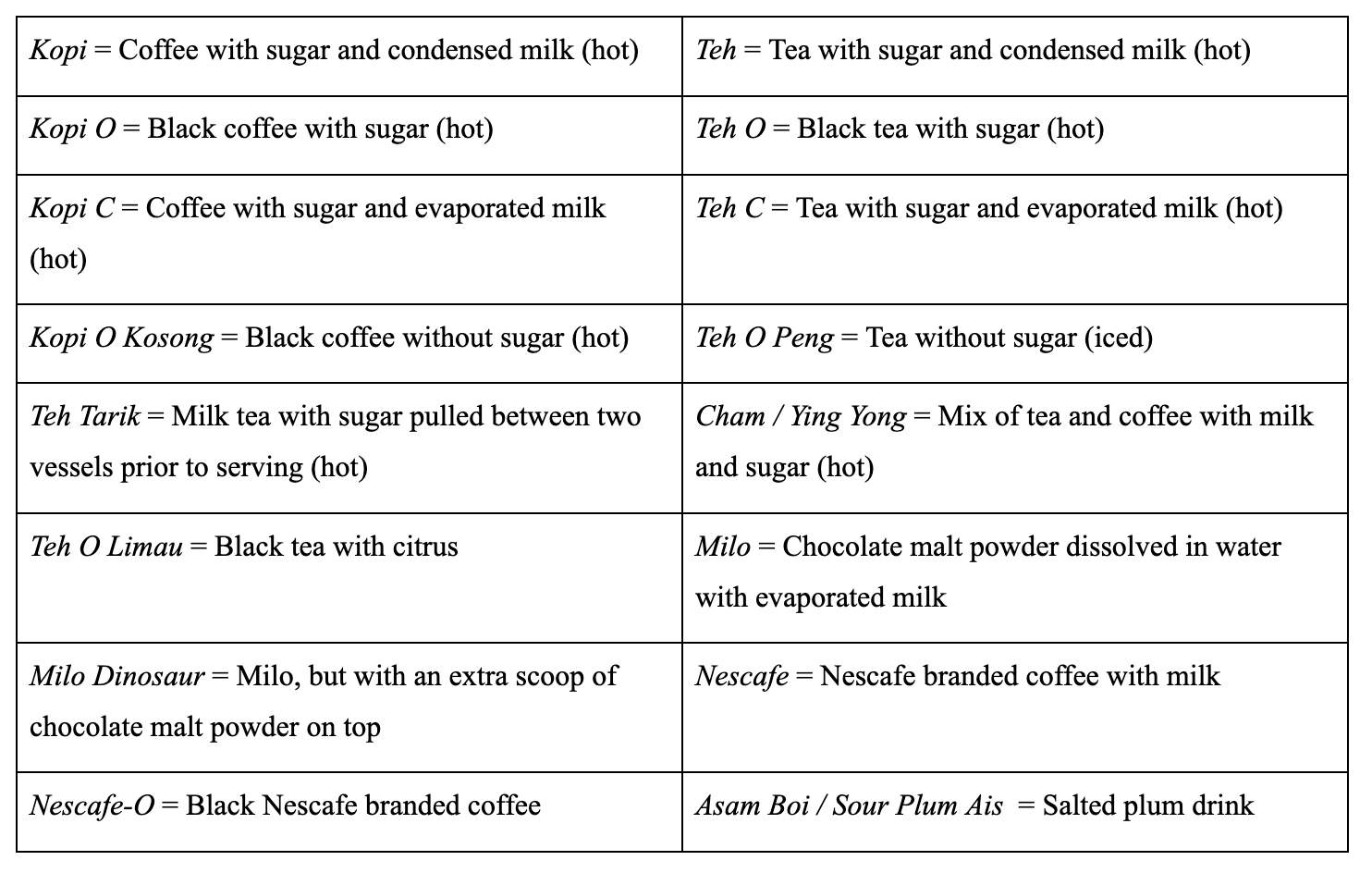
Other common drinks include Chrysanthenum and Barley teas, as well as soy milk with various toppings (cincau or grass jelly, and red bean). You can also tweak the order of any drinks listed to cater to your taste.
Kopitiams are the ultimate purveyors of comfort food, catering to regional cuisines and local preferences across the country. I’ve visited countless kopitiams during my visits to Malaysia, but have rarely found the same dishes being served.
An exception to this is roti bakar - a kopitiam staple. White bread is grilled over charcoal, then sandwiched with butter and kaya jam and soft-boiled eggs. The two can be eaten together - the eggs topped with soy and white pepper, which the toast is then dipped into, creating a sweet and savoury pairing. The beauty of the roti bakar is in the smoky flavor, imparted by a charcoal grill, which is topped with a luxurious amount of butter, thick enough to leave teeth marks. The final element, kaya jam, is made by caramelising sugar, eggs, and coconut milk into a thick caramel and is often flavoured with pandan (a tropical plant with a vanilla-like aroma). The result is rich, aromatic, and indulgent.
Other than these core menu items, food served in kopitiams across Malaysia varies greatly. Common dishes include noodles, soups, rice with various toppings, and other snack-type foods. Anything that can be prepped and quickly thrown together is appropriate for the fast-paced kopitiam environment - think Hainanese chicken rice, nasi lemak, and char kuey teow.
One of my favourites is the hakka mee from Chun Kei Tai Bu Noodle in Pudu, KL - bouncy egg noodles topped with savoury minced pork, slices of char siu pork, and kai lan (chinese kale). They are served alongside pickled chili and a bowl of pork wontons in broth. You can also choose to have the soup and wontons added to the noodle instead. The pickles add the perfect zingy and spicy balance to the fatty pork, while the soup provides a nourishing palette cleanser.
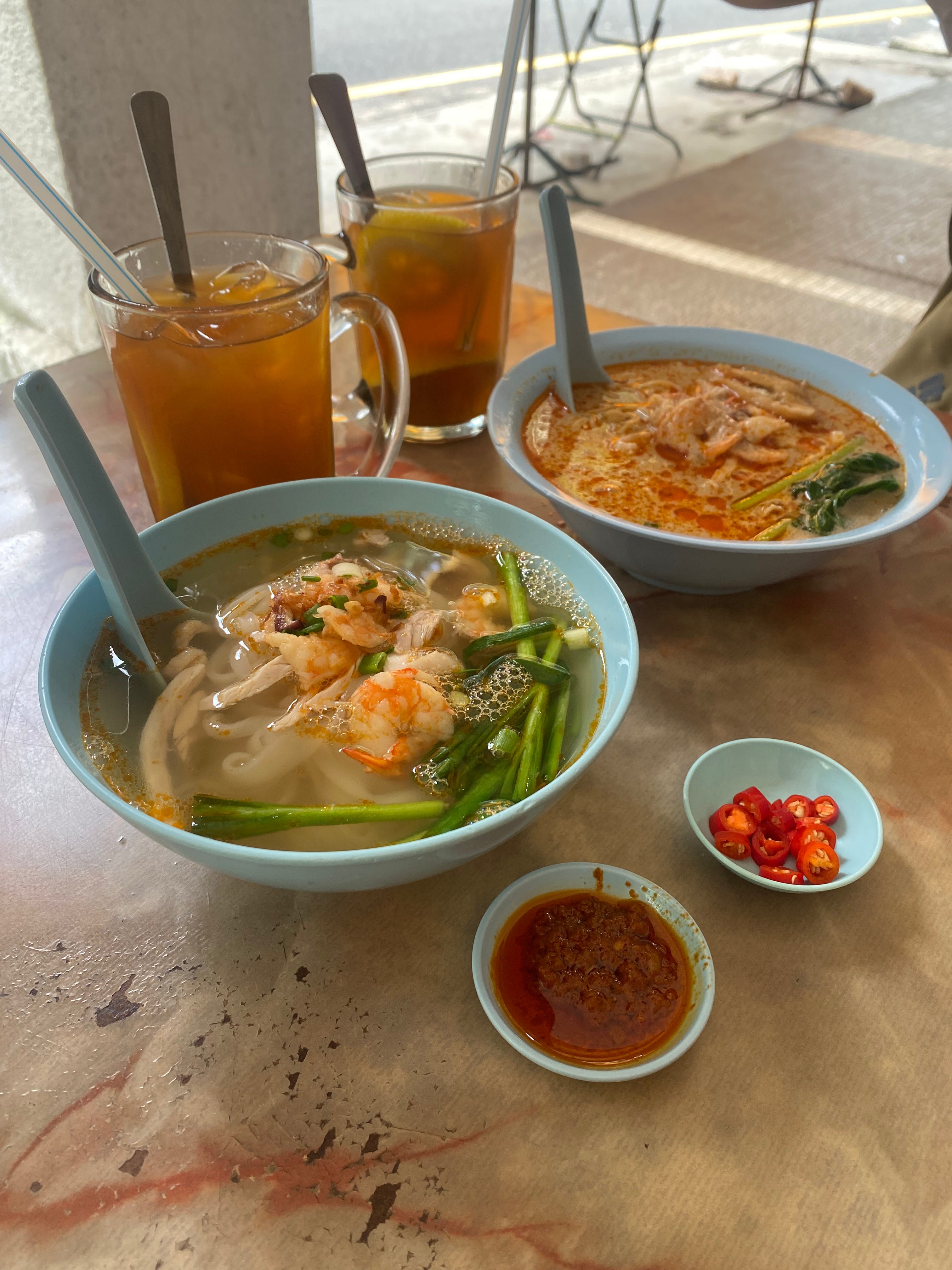
Restoran Pau Kee close to TRX is another great kopitiam for noodles in KL. Their signature ipoh sar ho fun is a comforting shrimp-based soup with flat rice noodles and green onion, topped with sliced chicken and more shrimp. The shrimp adds a natural sweetness to the soup which is hearty and satisfying. You can also request sambal and sliced chili to customize your bowl.
Kopitiams offer a doorway to nostalgia for Malaysian people, with affordable prices, comforting meals, and familiar faces. They tell a story of cultural convergence, and provide crucial space for social connection. Their significance within Malaysian culture is evidenced by the number of contemporary kopitiams and chains which now capitalise on their iconic aesthetic.


For me, a kopitiam is a place of simplicity and reliability. No matter where you are in Malaysia, you can always count on a kopitiam to provide you with a gratifying experience. I am forever looking forward to the familiar scent of a strong kopi, the creamy sweetness of an ais teh tarik on a humid day, and devouring a bowl of savoury noodles laden with pork lard.
This piece was written by Chloe Brownson. Living in Sydney, Australia, Chloe spends her weekend gardening and making sourdough bread.
This article was written on the land of the Gadigal people, of the Eora Nation.
https://sheere-ng.com/the-material-culture-of-kopitiam-cups/
https://link.springer.com/chapter/10.1057/9780230244474_5
https://eatingasia.typepad.com/eatingasia/2012/01/malaysian-hainanese-food-how-chicken-chops-became-malaysian-comfort-food.html
https://thesun.my/style-life/the-evolution-of-malaysia-s-kopitiams-to-cafes-XC9271202
Referring to the term by sociologist Ray Oldenberg, a ‘third place’ is “a familiar public spot where you regularly connect with others known and unknown, over a shared interest or activity”, https://www.thegoodtrade.com/features/third-place-community-spaces/
https://journal.pubmedia.id/index.php/jsd/article/view/3886
https://www.academia.edu/105761099/On_the_Construction_of_Identity_with_Regional_Lexical_Variant_Kopitiam_in_Malaysia
deleted user on Reddit, https://www.reddit.com/r/malaysia/comments/r01ef9/types_of_coffee_in_malaysian_kopitiam/
‘Laksa_Fan’ on Reddit, https://www.reddit.com/r/malaysia/comments/r01ef9/types_of_coffee_in_malaysian_kopitiam/
‘PROTROLLERs’ on Reddit, https://www.reddit.com/r/malaysia/comments/r01ef9/types_of_coffee_in_malaysian_kopitiam/