


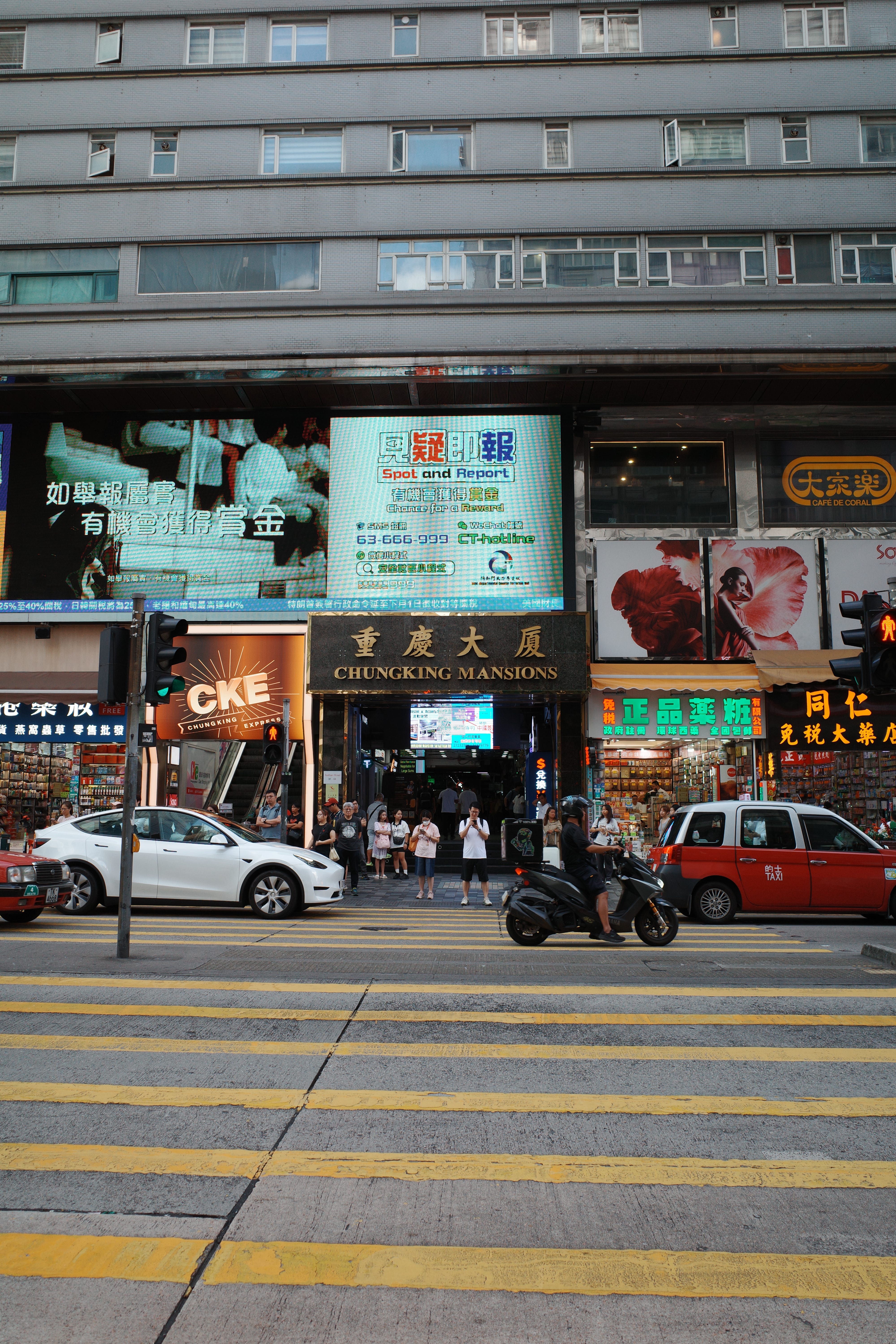
Nathan Road, Tsim Sha Shui, on a mid-July, weekday morning - the oppressive humid heat clings to you like a weight, double-decker buses packed to the brim relentlessly roll past, and pedestrians swarm at the edge of cross walks, many attempting to shield themselves from the sun with umbrellas. Nathan Road is a major thoroughfare of Kowloon Island in Hong Kong, traversing several suburbs and accommodating numerous entrances to the MTR system. As such, on any given day you will find it bustling with commuters, taxis, and buses.
On this day I was on a mission to visit the infamous Chungking Mansions, and to see for myself the diverse array of cuisines I’d heard were on offer. With company, a camera, and a notepad in hand, I made my way from Jordan to Tsim Sha Shui via the MTR, emerging just across the road via the station portal escalators. It stood out as I had imagined - an almost solid mass extending outwards and upwards from the entrance, grey in colour, covered in a grid of windows. I could spot a few neon moving signs, flashing behind the panes, advertising guesthouse rooms and restaurants within. The entrance to the building itself felt like a black hole sitting below the glistening, golden letters of Chungking Mansions.
Stepping inside, the interior offered little reprieve from the summer heat. Almost immediately, we were approached by a man holding out a business card asking if we were looking for a room to stay, “very cheap”, he says. After gently declining, we continued inside. Given it was just past 9 o’clock in the morning, many vendors were still closed or starting to set up. Inside was a large marketplace - stalls lined several corridors selling mobile phones, clothing, currency exchange, food, and more. The lighting struck me as quite dim, where certain corners and halls are left in darkness, while others are strobed with neon signs from shopfronts. Groups of people were milling around the outside of stores, most of whom I assumed were store owners and friends conversing with one another.


Ascending to the first floor via a single flight of stairs, this floor was distinctly more deserted than the ground during the morning hours. The majority of stores were shuttered and lighting was even more minimal. Our path was guided by the occasional fluorescent light which seemed to indicate where open businesses were congregated. Throughout both floors, many storekeepers rose to alertness as we walked past, encouraging us to enter their store or eat at their restaurant. Filipina women called out, “Filipino food ma’am, unlimited rice”, smiling as I walked by. Their stores were somewhere between a carinderia1 and a sari-sari2 store, with glass cabinets of pre-prepared dishes, and openings lined with hanging packages of snacks.
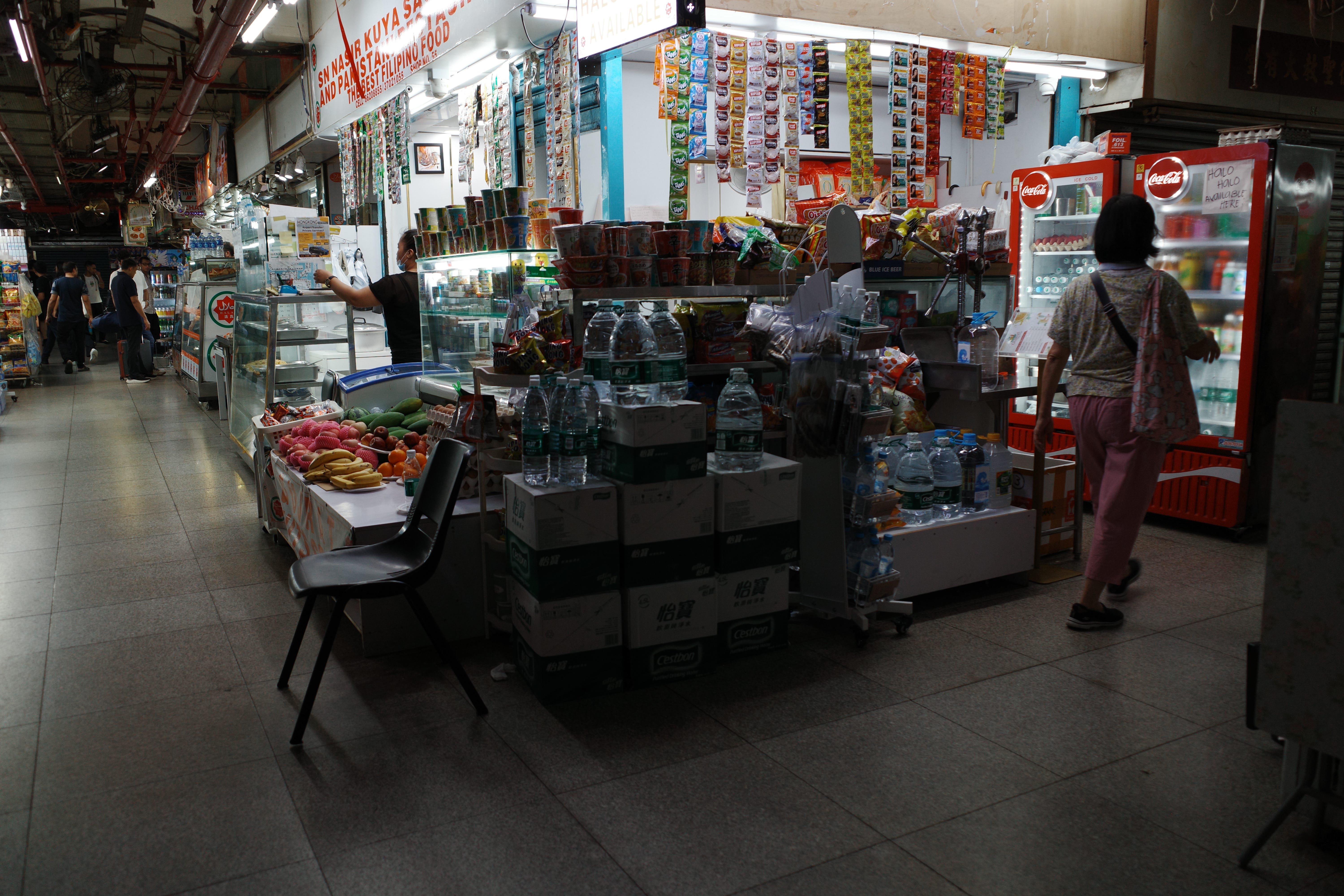
While I was aware there may be additional floors of shops from my research, we kept our exploration to the ground and first floors. The other floors were only accessible via an elevator, and it seemed from the signage that they may be shared with the entrances of guest homes and apartments. One thing that stuck out to me about the place is that it was not entirely clear where private versus public space began and ended.


In order to understand where this all came from, and why it appears in contrast with the dominant landscape of Hong Kong, it’s necessary to delve into the history of the building:
Chungking Mansions was constructed at the dawn of the 60s, which for Hong Kong was a period of economic growth and social transformation. The manufacturing industry began to boom, while colonial-era buildings were being replaced by high-rises.
The development of Chungking Mansions is linked to a Filipino-Chinese Businessman, Jaime Chua Tiampo, who purchased the land after moving his family to Hong Kong in 1938. The initial development on the site was a shopping centre known as ‘Chungking Arcade’, which opened in 1941. The building was later damaged by bombs during World War II.
In the post-war period, however, Nathan Road began to take shape into the ‘Golden Mile’ shopping destination that it is known as today. This presented an opportunity for Tiampo to redevelop Chungking Arcade into a multi-level residential and retail complex. Initial plans for the development faced a legal battle from existing tenants, however, approval was eventually granted for a 17-storey building of 5 blocks. When the retail component on the first 3 floors were opened in 1962 (the residential portion opened 1 year prior), it was renowned as the largest shopping centre in Hong Kong3.
Why then, has Chungking Mansions assumed the identity it is most associated with? - a dilapidated urban maze where foreign nationals congregate, illegal goods are pushed, and crime runs rampant? Anthropologist Gordon Matthew, author of Ghetto at the Centre of the World, believes this to be for three main reasons:
It’s affordability - Chungking Mansions offered a low-priced entry point for travellers and new arrivals to find food and accommodation;
A lack of strict regulations for non-visa holders - Hong Kong has a relatively relaxed approach to immigration compared to other countries, allowing visitors to stay up to 90 days without a visa; and,
The accessibility of Chinese-manufactured goods - with the growth of south China as a hub for manufacturing, Chungking Mansions became a point of distribution of Chinese and other international goods, for visiting entrepreneurs to purchase and bring home with them for sale.
The reputation appears to be traced back as early as the 1970s, as an article by Lonely Planet identified the building as a place for “hippies and backpackers” seeking “rock-bottom priced guesthouses”4. Fatalities and other instances of crime in the building throughout the 80s and 90s meant that negative perceptions of the place were built up within the public consciousness, with many Hong Kongers today still perceiving Chungking Mansions as unsafe. The 1994 film, Chunking Express, exemplifies this perception, as the plot follows the story of two police officers on duty in and around the building. The imagery depicts a place of dark alleyways and hidden rooms, where drug smuggling takes place alongside cheap late-night eateries and fluorescent-lit convenience stores.
Somewhere around the 00s, Chunking Mansions began being spruiked as a destination to sample flavours from around the world. In 2007, Time Magazine named Chungking Mansions as the “Best Example of Globalization in Action”5. Most notably, an episode of Anthony Bourdain’s Parts Unknown aired in 2018 where he visited the complex and sampled dishes from Northern India. Since then, an array of articles from travel blogs have been written with titles like ‘Where to Eat in Chungking Mansions’.
In my case, this idea was certainly true. It was clear that within its walls, Chungking Mansions held a wealth of colours, flavours, and textures to savour. Here are four places I visited on my trip:
Address: Chungking Mansions, Shop 105, 1/F, 36-44 Nathan Road, Tsim Sha Shui
Total cost: $187 HKD ($23.80~ USD)


Saravana Pure Vegetarian is a restaurant specialising in Jain vegetarian cuisine, offering regional dishes from both the north and south of India. For breakfast, we selected a couple of South Indian specialties - the masala dosa, and medu vada. The masala dosa is a papery thin and crispy crepe made of fermented rice batter, which is stuffed with a spiced mixture of potatoes and other aromatics. The filling stood out for its’ gentle yet fragrant flavours - looking inside you can see the hue of turmeric and flecks of mustard seed.
The medu vada are a fried doughnut-shaped fritter commonly found throughout the south of India, and typically eaten as a breakfast or snack food. They are made with a batter of urad dal (or black lentils), and seasoned with spices like cumin, fenugreek, and curry leaf. The medu vada were fluffy and slightly dense in a satisfying way. The highlight of the vada is the texture: fluffy and dense at the same time with that quintessential tang you find in all fermented rice dishes birthed from South Asia. The flavor comes from the array of rainbow condiments dolloped on the outskirts of your plate.
Both dishes were served alongside three condiments - sambar (a thin stew of lentils and vegetables), tomato/chilli chutney, and a coconut chutney. An additional condiment which was provided to each table was a mixed pickle. It offered a punchy sourness, which I deduced came from lime, and was a perfect complement to the rest of the dishes. We washed down the meal with a masala chai and mango lassi. The masala chai was the perfect level of sweetness for my taste, with strong notes of cardamom and cinnamon. Mango lassi is a blended mango and yoghurt drink - a refreshing palette cleanser to sip between bites.
786 Food Store
Address: Unknown (located on Ground Floor, to the right of entrance)
Total cost: $60 HKD ($7.60~ USD)
For a mid-morning refreshment, we were drawn to a store with a large display of colourful fruits. The owner warmly beckoned us to look closer and try his products. We settled for two watermelon juices - simply watermelon blended with ice, nothing complicated. The store also offered pre-cut fruits to eat, and whole fruits to take away. As expected, it was perfectly balanced, icy cold, and refreshing.
Gorkha Palace
Address: Chungking Mansions, 101 & 101B舖, 36-44 Nathan Road, Tsim Sha Shui
Total cost: $99HKD ($12.60~ USD)


Gorkha Palace serves Nepalese and Northern Indian dishes within an air-conditioned restaurant environment - a welcome respite from the humid halls of Chungking Mansions in July. As a light lunch, we decided on chicken momos, being the chef’s special, and papdi chaat.
Momos are a type of Nepalese dumpling. You can also have them served steamed, fried, or in a savoury sauce known as jhol. We opted for a simple steamed version, with a dipping sauce on the side. The momos were filled with spiced chicken mince and vegetables, while the dipping sauce was bright, zesty, and spicy. The sauce is typically made of a blend of tomato, chilli, garlic, and ginger.
The papdi chaat was a light and cooling accompaniment to the momos - crispy crackers topped with yoghurt, tamarind chutney, cilantro chutney, and sev (crispy fried chickpea strands). Chaat is one of my favourite genres of Indian food, which I can never resist. I love the combination of the tangy, cooling yoghurt, mixed with the sweet and sour tamarind, and the herbaceous green chutney. The papdi crackers manage to stay ever so crunchy even after being loaded up with sauces.
Ghana Locals
Address: Chungking Mansions, 號105/94號, 36-44 Nathan Road, Tsim Sha Tsui
Total cost: $100HKD ($12.70~ USD)
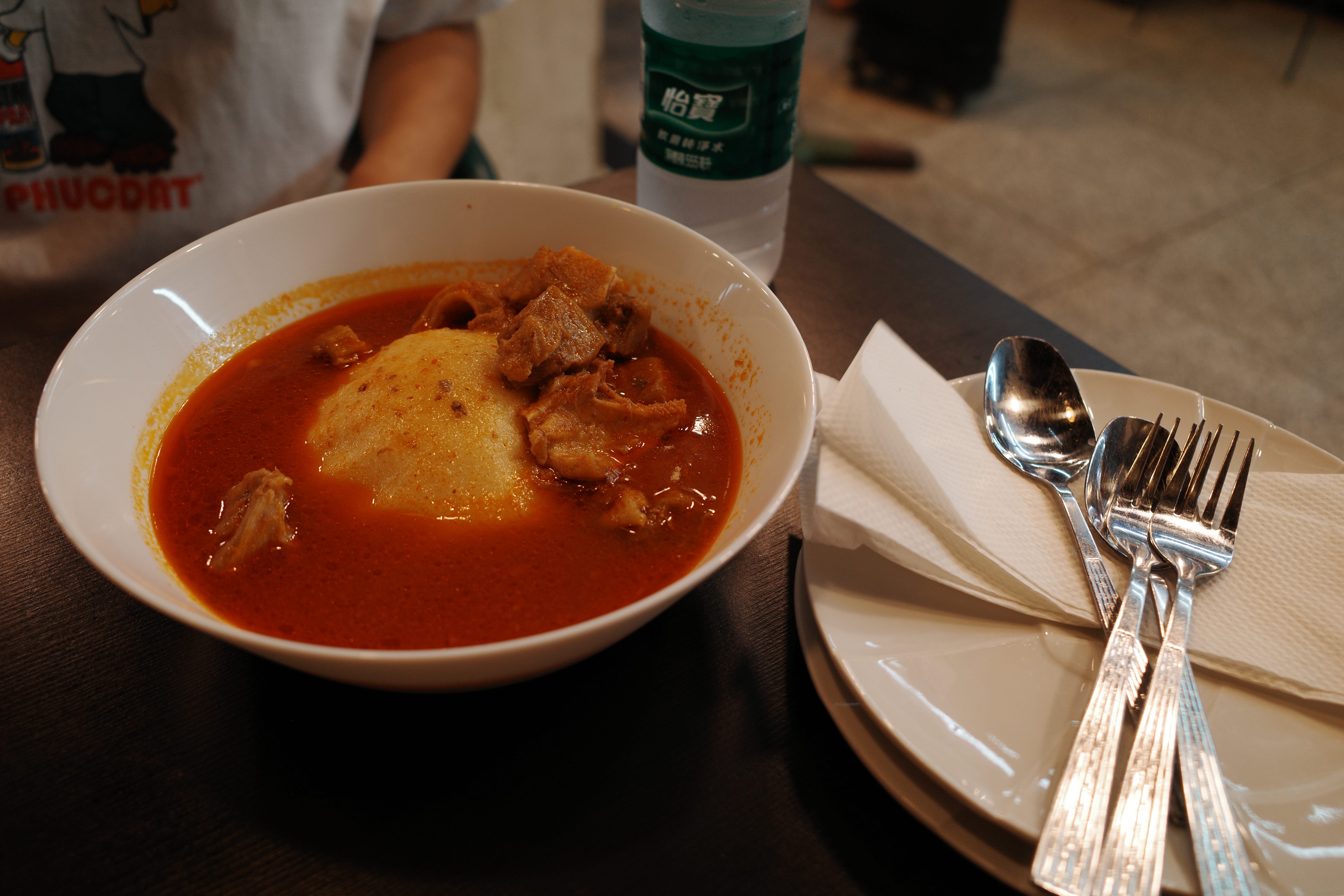
At around 2pm in the afternoon, my stomach was nearly bursting at the seams. However, I was determined to try one last venue I had heard about. Ghana Locals serves largely Ghanaian and Nigerian dishes, and is probably one of the most well-known restaurants in Chungking Mansions.
I was immediately drawn to the peanut soup with goat meat and fufu. The dish arrived speedily to our table, a bowl of steaming stew with a reddish hue. It was filled with tender chunks of goat meat, and you could observe the fats and oils from the meat making the surface glisten. Tasting the soup first, it was immensely umami, slightly nutty, and a little spicy, with notes of tomato and peppers. The liquid coats your mouth in a satisfying way, and the spices linger on your tongue, leaving you in anticipation of the next bite. The meat, of course, was delightfully soft and juicy.
The fufu (a form of pounded dough commonly eaten with soups and stews across West Africa) was made with cassava, and sat like an island in the soup. It has a neutral and slightly sweet flavour, with a starchy texture, not entirely unlike mashed potato or polenta. However, it has a much more dense and stickier consistency. It is an extremely satiating vehicle to soak up the rich liquid of the peanut soup.
One thing that surprised me on my visit was the uncovery of a basement mall forming part of the building, just left of the main entrance. Heath Mall - a flashy, modern shopping and dining hall, something one might imagine to stumble across on Hong Kong Island. It’s website reads:
“Sprawling across 40,000 square feet in the basement of Chungking Mansions, Heath is the next culture, retail, and dining destination you need to know. The space is designed with the goal of being a microcosm of Hong Kong — trendy cafés and generations-old noodle shops, hidden art spaces and buzzy food courts — all grounded in an unfussy and uniquely Hong Kong sensibility”6.
The mall itself was filled with neon lights, souvenir stores, claw machines, photo booths, and modern art installations. There also appears to be a regular schedule of events aimed at attracting the young, ‘cool’ crowds of the city. I suppose, even Chungking Mansions isn’t immune to the forces of gentrification.


This piece was written by Chloe Brownson. Living in Sydney, Australia, Chloe spends her weekend gardening and making sourdough bread.
This article was written on the land of the Gadigal people, of the Eora Nation.
A carinderia is a local eatery or canteen commonly found across The Philippines where one can eat home-style Filipino dishes from a buffet offering.
A sari-sari store is a neighborhood convenience store selling a range of household goods and snacks.
https://industrialhistoryhk.org/jaime-chua-tiampo-%E8%94%A1%E5%A4%A9%E6%99%AE-developer-of-chungking-mansions-%E9%87%8D%E6%85%B6%E5%A4%A7%E5%BB%88/
https://www.google.com.au/books/edition/Ghetto_at_the_Center_of_the_World/Ks-sZHUFTd4C?hl=en&gbpv=1&printsec=frontcover
https://www.heath.hk/
